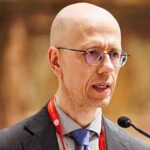
Nineveh Plains (Iraq): ACN begins the reconstruction with the “Olive Tree Ceremony”
On Monday morning, the pontifical foundation Aid to the Church in Need consecrated three building sites in the villages of Bartella, Karamlesh and Baghdeda (Qaraqosh) for the reconstruction of the first 105 houses belonging to internally displaced Christian families. The owners of the houses were each given a small olive tree so that these can grow in their gardens as a symbol of peace and reconciliation.
Erbil (Iraqi Kurdistan), 9 May 2017 – As fragile as a young olive tree, as imperceptible as the mustard seed from the parable from the Gospels – so begins the reconstruction of the first houses of 105 Christian families in the villages of Bartella, Karamlesh and Baghdeda (Qaraqosh) on the Nineveh Plains. Work on the first building site in Baghdeda will already get underway this Thursday (11 May).
The source of this newfound hope are the churches located in the villages that were plundered and destroyed by the self-appointed Islamic State. The attacks carried out by IS on the Nineveh Plains in August of 2014 forced around 130,000 Christians to leave their homes and find refuge in Kurdistan. Yesterday morning, Philipp Ozores, General Secretary of the pontifical foundation Aid to the Church in Need (ACN), presented olive trees to 35 Syrian Orthodox families in the small church of Mor Shmuni in Bartella. The rebuilding of their houses, which will occur over the course of the next few days, was arranged by the Nineveh Reconstruction Committee (NRC). The committee is made up of representatives of the Syriac Orthodox, Syriac Catholic and Chaldean churches as well as three consultants appointed by Aid to the Church in Need and has the job of planning the reconstruction of almost 13,000 Christian houses destroyed by IS on the Nineveh Plains.
In Bartella, 1,451 houses belonging to Syrian Orthodox families have to be rebuilt. Seventy-five of these were completely destroyed, 278 burned down and 1,098 partially damaged. Water and electricity services could only be restored a few days ago.
In his sermon during the olive tree presentation ceremony, Archbishop Timothaeus Mosa Alshamany of the Syriac Orthodox church of Antioch, who is also prior of the Monastery of St. Matthew, made no secret of the difficulties of this undertaking. “A few months ago, we were waiting for the liberation of our cities. Today, we are waiting for reconstruction. Returning to our cities is even more difficult than fleeing from them.”
Following the ceremony in Bartella, the little “convoy of hope” continued on to Karamlesh. There, Philipp Ozores, Father Andrzej Halemba, head of the Middle East section of Aid to the Church in Need and interim chairman of the NRC, as well as Father Salar Kajo, who is responsible for the rebuilding efforts in the Chaldean villages of Tel Skuf, Bakofa, Badnaya, Tel Keppe and Karamlesh, presented olive trees to 20 additional families. The ceremony took place in the Chaldean church of Mar Addaii, which was also partially burned down by IS.
After the ceremony, 76-year-old Habib Yuossif Mansuor recalled the suffering of having to leave one’s own village. “We looked the pain in the eye. We fled after midnight, leaving our houses and all of our possessions. I had a two-storey house here in Karamlesh that was bombed to the ground. We all speak the same language, and so we would like to return to our cities on the Nineveh Plains as brothers, as though we have only one heart. We want to live and work together, as though we are just one body. We thank the Lord and Aid to the Church in Need.” In Karamlesh, 754 houses need to be repaired. Of these, 89 were completely destroyed, 241 were burned down, and 424 were partially damaged. The water supply has been up and running again since yesterday: a small, but important sign of hope.
The last of the olive tree ceremonies took place in Baghdeda. Here, 6,327 houses belonging to Syrian Catholic Christians need to be repaired. Of these, 108 houses were completely destroyed. These are in addition to the 400 houses belonging to Syrian Orthodox Christians (of these, only 7 houses were completely destroyed). However, there is no lack of enthusiasm or skills: 40 engineers have “signed on” to rebuild the city and about 2,000 workers are ready to begin work. Electricity is slowly being returned to the entire city.
In Althajra Cathedral, which is consecrated to the Immaculate Conception and was set on fire by IS so that the smoke would confuse American military aircraft, Philipp Ozores and the Syriac Catholic Archbishop of Mosul, Kirkuk and Kurdistan Yohanna Petros Mouche presented olive trees to 50 families. The archbishop had to wait for the applause to end several times before he could continue with the sermon he was holding in the cathedral. He pointed out that unity was the only means of achieving the shared goal. “We do not want to pay attention to the voices of those who would discourage us because they want to prevent the reconstruction. We stand by our decision to return, despite all the challenges that await us. Christ is our tower of strength that gives us hope. We must persevere, because this is our soil and our heritage. I am very happy that we have an organisation like Aid to the Church in Need at our side.”
Azhaar Naissan Saqat also thanks Aid to the Church in Need. Originally from Baghdeda, the 46-year-old assistant physician lived in Erbil for three years as an internally displaced person, where he manages two outpatient clinics for displaced persons. “We had almost lost all hope, but after such a long wait, we were able to return to our city thanks to the support of Aid to the Church in Need and other organisations that helped us to rebuild our houses – first and foremost Aid to the Church in Need. This foundation made it possible for us to hope once more that we would be able to return to our homes and our churches and lead normal lives again.”
Philipp Ozores, General Secretary of Aid to the Church in Need, said, “Today, we would like to hold on to this small sign that we are once more at the point of departure – just as in the parable of the mustard seed from the Gospels. But with God’s help and that of our benefactors, we hope that the Nineveh Plains will be able to welcome back the Christians who were forced to flee. We hope that this region may soon become a place of life and peace for all once more.”
Next weekend, the olive tree presentation ceremony will also be held in Tel Skuf, a Chaldean village with 1,268 houses that need to be rebuilt. The majority (1,123) of the houses there have sustained only slight damages, which means that the hope for a speedy resettlement of the village is more than justified. In fact, 500 Christians families have already returned to Tel Skuf.

Recommended