“My father was killed two days after my birthday. I will always remember his smile right before he died. ”
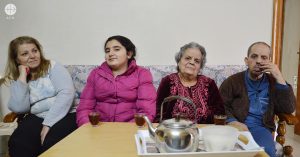
[vc_row][vc_column][vc_column_text]MARIAN NABIL HABIB refers to this day as “the martyrdom of my father.” Nabil Habib was 48; he was among the 29 people who died Dec. 11, 2016, in a suicide attack claimed by ISIS. The targets were worshippers at St. Peter and St. Paul’s Coptic Church in Cairo, also known as El-Botroseya Church. Marian, who is 15, tells her story to the pontifical foundation Aid to the Church in Need, with some of the details of that dark day gleaned from the church’s security cameras.
“That day was a watershed in my life and the life of my family. I always feared that I would lose one of my family members and then it turned out to be my father, who was a good friend to me. I will never forget the details of that day.
“We live in an apartment in the compound of St. Mark’s Coptic Orthodox Cathedral, where El-Botroseya Church is located. My father worked as a guard of the church. I celebrated my birthday two days before the attack and I exchanged laughs and jokes with my dad that day. Then, the day before the attack, my father did not seem normal. He came back repeatedly to our apartment to check on my younger brother, Fadi, who is two years-old.
“That Saturday evening, the suicide bomber had come to the church and asked dad about religious books, saying that he wanted to know more about Christianity; a deacon overheard the conversation and told the young man to come back the next morning at 10AM.
“On Sunday morning, as soon as my father saw the young man he recognized him; the bomber was quickly making his way to the women’s pews, looking confused. My father got on the phone with my uncle to tell him about the man, but quickly ended the call to give chase. Next, the suicide bomber blew himself up.
“Just a few minutes before the explosion, my father had asked me to go to our apartment and prepare a cup of tea for him. When I heard the explosion, I thought that the kettle had exploded. But soon there was thick smoke and bricks fell from the kitchen walls. I rushed outside and found people running in all directions, screaming hysterically. There was a scene of complete destruction, but I still I did not know what had happened.
“I asked about my father but nobody knew where he was. I continued looking for him; then, at the entrance of the church, I found my father lying on the ground and bleeding heavily from his head. I took off my jacket for his head to rest on. There were wounds across his entire body; his hand looked shattered; my hair got wet with his blood.
“He was still alive and, looking me in the eyes, he told me to take care of my younger sister and brother; and he gave me the keys to the church gate and to our apartment. I will always remember his smile right before he died.
“Before all this happened I had worried for a long time that I would lose something precious. Losing my dad put me in a state of shock for more than a month and a psychiatrist visited me. Finally, it was God’s mercy, his consolation, which helped me recover.
“I feel great comfort from God and I also got support from the Church, my friends, and many of people around us; there also has been great interest from people from other countries and international bodies that visit us to this day.
I do not feel scared now—but I still long for my father and my little brother needs his hugs; we miss him very much. I do not want to leave my country and the place where my father served and lived his whole life. All my memories of my father are here.
Despite the pain, my life has changed for better: I feel stronger than before and I care more about my studies than ever before—the future no longer frightens me. I have joined the church choir, which gives me inner peace, because it is one of the things that bring me closer to God.
“My message to all those who suffer, and who might read my words: do not be afraid. God is great and I ask everyone to pray for all people facing violence and hatred; we must pray for peace around the world.
Looking farther ahead, Marian says she wants to eventually study medicine—“because that was the dream of my dad.”[/vc_column_text][/vc_column][/vc_row]

Recommended