Argentinian Patagonia: Mission country
The Church in Patagonia faces unique challenges, marked by vast distances, great diversity and lack of resources. One of the bishops in charge of overseeing the development of the Church in this vast territory of Argentina is Mgr Roberto Álvarez, who sat down with Aid to the Church in Need (ACN) to share his dreams and difficulties.
Bishop Roberto Álvarez has been shouldering a double responsibility since October 2023, when he was appointed head of the newly created Diocese of Rawson and also the Apostolic Administrator of the Diocese of Comodoro Rivadavia, both in Argentinian Patagonia. On 17 February, he is set to be installed as the Bishop of Rawson, a diocese that is taking its first steps facing unique difficulties. “The Patagonian Church is special, and very different from the rest of Argentina. For example, we are a land of evangelisation, a mission country. This region does not have deep Christian roots, in that sense we are more like Uruguay”, Bishop Álvarez explains, pointing out that the province of Chubut, where Rawson is located, is historically characterised by strong migration.

“This area used to be inhabited by Mapuches-Tehuelches, but in the 19th century it was settled by Welsh immigrants. Nowadays we get people from Bolivia and Paraguay, which gives it a unique cultural and religious diversity compared to the rest of Argentina. There is also a large Protestant presence here, which is also not common in other parts of the country”, he explains.
One diocese, one hundred thousand kilometres
Perhaps the greatest challenge of all is the distance between communities. The new diocese covers around 100,000 square kilometres, a surface area larger than Portugal or Austria. The reality the bishop describes sometimes requires extreme sacrifices. “There are no trains here, and hardly any flights, so we use the car to get around. In some of the rural areas you need a 400 km round-trip to celebrate Mass.”

In order to attend the Patagonia-wide pastoral meeting, some participants, such as those who travelled from Usuahia, have to drive 1,500 or 2,000 kilometres. “But they do it, and with great joy, because they know how important these gatherings are for the future of evangelisation. Sometimes we can count more on them here in Patagonia than in other places I worked before, where distances were much shorter”, the bishop comments. He also needs to cover hundreds of kilometres to fulfil his responsibilities. For example, at the end of January, he drove 807 kilometres to attend the binational peace and fraternity meeting between Chile and Argentina, which takes place at the border crossing in the southwest of Chubut province.
Given this particular context, Bishop Álvarez highlights the importance of clergy formation. Of the 12 priests he has in the Diocese of Rawson, only six are Argentinian, but just three are from Patagonia. “I only have a handful of priests, which means that the laypeople are called to truly fulfil their baptismal mission, we really need them. Because of the enormous distances, we need to care for our priests, accompany them. This year we had the first meeting for young clergy, and they were really happy.”
Financial challenges
Another challenge Bishop Álvarez has to deal with is lack of resources, which has become more serious over the past eight to ten years. “When you don’t have anything, you don’t have any personal concerns. All I worry about is the economic upkeep of my pastoral agents in the diocese”, he says. “Look, I have just finished ironing my clothes. I don’t have my own house. I wash, I iron, I do everything. I live off the charity of my priests, who provide me with a bed and food. There is always a priest available to provide you with a pillow in his parish”, the bishop explains. “But despite the economic and geographical difficulties, I am very happy”, he adds, with an infectious joy.
The combination of difficulties, vast distances and lack of resources makes it difficult to sustain the new diocese. For the priests, a simple trip can translate into considerable costs, sometimes equivalent to a full month of parish income. “This is why the help you give me for training courses and Mass stipends is so important. Without the help of ACN it would be impossible to cover all the fuel costs for our pastoral work”, Bishop Álvarez says.

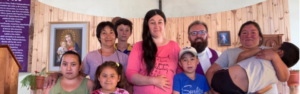
ACN also helps to support the Sisters of Saint John the Baptist, a Mexican religious community that does extraordinary work in a 250 square kilometre radius, which includes remote communities of the new diocese, such as Las Plumas, Dique Ameghino or Escorial. In these regions, where roads are little more than rocks and sand, the sisters carry out pastoral and social work with the poorest of families, taking with them the consolation of God, but also food and medicine. “They live in great austerity, enduring temperatures of up to 10 degrees below zero. They have permission to conduct baptisms and weddings, because the closest priest is several hours away. The help they get from ACN is also indispensable, without it they would not be able to cover their expenses”, Bishop Álvarez says, gratefully.
By Maria Lozano.

Recommended