A picture of helplessness on the Venezuelan frontier
Since the recent controversial presidential elections in Venezuela (in which President Maduro was re-elected in a manner deemed fraudulent by his opponents), the flood of migrants seeking better prospects in other nations has continued to grow, creating an emergency in which thousands of Venezuelans are in need of help as they attempt to cross the frontier between Venezuela and Colombia.
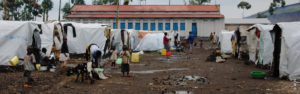
On the Simón Bolívar International Bridge, which links the two cities of San Antonio del Táchira (Venezuela) and San José de Cúcuta (Colombia), the security checks are strict for everyone attempting to leave Venezuela, a country that is undergoing a grave political, economic and social crisis. Many people do not succeed in crossing over the frontier, and as a result they are forced to wander the streets of this frontier town in search of humanitarian aid.

That is what happened to Fernando and Marisela and their two children Luis and Camila, aged three and seven respectively. They travelled from Caracas, hoping to cross the frontier with the aim of travelling as far as Ecuador, but owing to difficulties with the children’s papers, they were unable to leave the country.
“Life is difficult in the capital; it’s better to emigrate”, says Fernando. But now, with dwindling funds, they have to spend the nights in the town square, along with other would-be migrants, and do casual work while trying to find a solution to their problems and continue their journey.

A report published by the International Organisation for Migration (IOM) on 14 May this year indicates that the number of Venezuelan migrants in Latin America and the Caribbean grew from 89,000 in 2015 to 900,000 in 2017 – a growth rate of over 900%. And that is without counting the Venezuelan citizens who cross the border illegally into Colombia or Brazil.
For Bishop Mario Moronta of the diocese of San Cristóbal in Venezuela, the situation on the frontier here is “a picture of the helplessness of so many Venezuelans who cannot obtain even the most basic necessities for daily life – food, medicines and other suchlike things”.
Faced with such a situation, the bishop assures us, “The Church, moved and guided by the Holy Spirit, is trying to address the situation with her charitable work, doing whatever lies within her power, humanly speaking, to help the migrants.”

Hundreds of people cross this bridge every day on foot – as it has been closed to vehicular traffic since August 2015. Some people use this crossing in order to travel on to other countries of South America, while others head for the city of Cúcuta, hoping to buy food or medicines and then return. A few people decide to stay on at the frontier, seeking casual work of one kind or another.
Like young Andrés Vargas, for example. Aged 18, he travelled from Barquisimeto, hoping to get to Chile, but his money ran out, so he decided to stay at the border. “Here I manage to earn a little money taking other travellers to the ticket sales office, and that’s enough for me to eat and from time to time pay for accommodation”, he explains.

Some people, after a long journey, find themselves unable to cross over because they have arrived at the wrong time, since the crossing is completely closed from 8 p.m. to 6 a.m. That is what happened to the Fonseca family – father, mother and their three young daughters – after travelling for 12 hours by bus from Valencia. When they arrived at San Antonio, the crossing was closed, so they had to spend the night in the street in the open air. “It was an adventure. That unpleasant night was like nothing we had experienced in the last few years”, Carlos Fonseca explains.
Father Reinaldo Contreras, the rector of the Basilica of Saint Anthony of Padua, which is just a few metres from the frontier, explains that the Church is responding to this situation through her social outreach – but “with great difficulty, given the shortages and the high prices of food and the lack of any infrastructure for providing adequate care for the migrants”, he adds.
Nevertheless, the parishes on this major frontier crossing run regular daily feeding programs so as to be able to provide the most vulnerable migrants with at least one square meal. Father Reinaldo also explained how they are investigating the possibility of doing up some kind of a centre as a migrant hostel, so that they can offer a more comprehensive form of aid.
Many of the migrants who succeed in crossing the frontier into Colombia also receive help from the “Casa de Paso Divina Misericordia”, the Divine Mercy overnight shelter belonging to the diocese of Cúcuta, which provides them with medical services, pastoral support and also gives out over a thousand meals daily.
Bishop Victor Manuel Ochoa of Cúcuta, who has recently been in contact with the international Catholic pastoral charity and pontifical foundation Aid to the Church in Need (ACN), described the situation as “a drama of suffering” and asked for our prayers. “The Church is present here on the frontier. We wanted to be a helping hand to accompany our Venezuelan brothers and sisters in their suffering. I recall how Father Werenfried, the founder of ACN, provided food for the refugees in 1947. We want to follow in his footsteps. I ask you all to pray for Venezuela and for Colombia, that we may be able to find a way of peace and reconciliation.”
Aid to the Church in Need recently visited the town of San Antonio de Tachira, in Colombia, in order to offer support and show solidarity with the dioceses on the frontier between Venezuela and Colombia in the present difficult situation and to study the possibility of providing support in the future for the planned migrant hostel, the Casa del Migrante.

Recommended