West Bank: “Honestly? The ceasefire has made the situation even worse”
Gaza is currently experiencing a fragile peace, but a visiting delegation from ACN found that the situation in the Westbank has not improved for Christians, who must struggle to find reasons to hope in the future.
It takes around 20 minutes to drive from Ain ‘Arik to Ben Gurion Airport. Or it could, if not for the roadblocks and the fact that Palestinians are forbidden from using Ben Gurion since the beginning of the war in Gaza.
The consequences of these obstacles are very real for the 85 young Palestinian Christians who are planning to travel to Rome for the Jubilee of the Youth in July and August. Instead of the 20-minute drive to the airport, they face an overnight bus drive to Jordan and a major increase in costs.

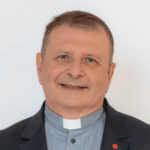
This is the new normal in the Palestinian territories in the Holy Land, Fr Louis Salman, who is in charge of the pastoral chaplaincy for the youth in all of the West Bank, Gaza and Jerusalem, told a delegation from Aid to the Church in Need (ACN) who visited the Holy Land. Travel restrictions leave people feeling isolated and trapped, lack of job opportunities sap their prospects and constant exposure to violence leaves them traumatized.
With the ceasefire that recently came into effect in Gaza, might the future look a little brighter for Christians across the Holy Land? “Honestly? For us, in the West Bank, the ceasefire has made the situation even worse,” said Fr Louis. “Since the ceasefire they have closed even more roads, made travelling even more difficult. The road from Jifna to Zababdeh used to take around two hours, now it takes four,” the Jordanian-born priest explains. The ceasefire agreement saw Israel commit to releasing Palestinian prisoners, many of whom returned to the West Bank. “Because of the prisoner exchange, they have tightened security,” Fr Louis explains.
Cardinal Pierbattista Pizzaballa, the Latin Patriarch of Jerusalem, agreed during a meeting with ACN in Jerusalem. “Absolutely, things in West Bank are worse. When the ceasefire started in Gaza, they started operations in the West Bank, with hundreds of checkpoints, and operations in Jenin (a major Palestinian city).”

Sami El-Yousef, the CEO of the Latin Patriarchate of Jerusalem, backed up those positions with facts. “We have seen more annexation of land in the West Bank, as well as the eviction of around 16,000 people from refugee camps in Jenin, with the physical infrastructure being razed, so they have nowhere to return to. The West Bank is now completely fragmented with 185 gates and over 900 checkpoints, but because of what has been going on in Gaza, none of this gets much international attention.”
“I don’t know how we are still standing. The tide is very much against us,” Sami El-Yousef said. Yet he tried to find a silver lining to the whole situation. “As a Church we feel we are stronger than one-and-a-half years ago, specifically because of our contributions to society at large. We were able to maintain our services, expand them at some points and serve Gaza and West Bank communities who were most affected by the war, and we are preparing ourselves to be of more service after the war.”
For example, he explained, following concerns expressed by Patriarch Pizzaballa that the people of Gaza were suffering from lack of fresh produce, the Latin Patriarchate of Jerusalem managed to secure the provision of fruit and vegetables to Gaza for several months, and not only to the tiny community of Christians who are still living in the Catholic and Orthodox compounds.

“Until today, people talk about how the Church stood up for them. In line with the Patriarch’s wishes, we extended our generosity to our neighbours. We are very proud to have done what we have done in this period,” Sami El-Yousef explained.
Much of this work has only been made possible because of aid provided by ACN, a fact which the CEO of the Latin Patriarchate mentions with extreme gratitude. “The past year and a half solidified what we Christians already knew, that we have friends all over the world, who help us not only with money, but also with moral support,” he explained.
Meanwhile, the environment in the Holy Land makes Fr Louis Salman more determined to introduce young Christians to international experiences such as the upcoming Jubilee celebrations in Rome. “After one year of war, most of our young people are desperate, and the idea is to boost their spirits. The goal is to have a deep spiritual experience, not just to have fun. Psychologically it is important to participate in international activities to understand that globally they are not a minority.”
The theme of this year’s jubilee is hope, but for many Palestinian Christians, hope is non-existent or in very short supply. Sitting in the headquarters of the Youth of Jesus’ Homeland ministry, which was refurbished with the help of ACN, Fr Louis Salman explained that part of his mission as head of the youth chaplaincy is to explain to them where true hope lies. “Unfortunately, today there is no hope. But we always want to bring them hope, a hope that does not come from politics, but from Jesus. And that is why, as Christians from Jesus’ homeland, we have a duty to stay here, where He lived, where He died, and where He rose again.”

Recommended