Religious Persecution: “Our silence is our shame”
On May 28, 2019 the UN General Assembly passed a resolution establishing August 22 as the International Day Commemorating the Victims of Acts of Violence Based on Religion or Belief. The proposed observance was tabled by Poland with the support the United States, Canada, Brazil, Egypt, Iraq, Jordan, Nigeria and Pakistan.
The pontifical charity Aid to the Church in Need, serving the suffering and persecuted Christians for over 70 years, welcomes this resolution as a first step towards drawing greater attention to the as yet under recognized tragedy of religious persecution – particularly that of violence against Christians, to date the largest faith group experiencing persecution for religious belief. Maria Lozano interviewed Mark Riedemann, Aid to the Church in Need’s Director of Public Affairs and Religious Freedom.
Do you know how did the idea originate?
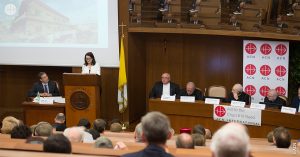
The initiative was initiated and carried out by Ms. Ewelina Ochab, lawyer, author and co-author of a number of books and articles addressing religious freedom. In September 2017 after the success of the ACN-hosted international conference in Rome presenting the post-Daesh reconstruction of the Christian villages in the Nineveh Plains, Ms. Ochab proposed drawing global attention to religious freedom violations, and more specifically Christian persecution. We encouraged her call for action by the international community.
![International Conference "Return to the roots: Christians in the Nineveh Plains" hosted by Aid to this Church in Need: Ewelina Ochab [the author of the book “Never Again: Legal responses to a broken promise in the Middle East” (2016)].](https://media.acninternational.org/wp-content/uploads/2019/09/WEBSITE_template_gallery2-4.jpg)
Is this a useful step? How can this promote religious freedom and prevent religion based violence?
This is not only a useful but crucial step. To date the international community’s response to religion based violence, and religious persecution in general, can be categorized as too little too late. This resolution is a clear message and mandate – and every August 22 a reminder – that acts of religion based violence cannot and will not be tolerated by the UN, member states, and civil society.
By implication, the protection of those suffering religion based violence is also a recognition of religious freedom: an acceptance of the sociological reality of religion in society, the positive role of religion in societies in guaranteeing plurality and furthering economic development, and, as Pope Benedict XVI stated, the fundamental right of the individual to seek Truth, to seek the transcendent, to seek God.
Is this a sign that religious violence is taken more seriously internationally and by the UN?
Tragically, research from international religious freedom reports such as those published by the United States Commission on International Religious Freedom (USCIRF), the Pew Research Center, and Aid to the Church in Need confirm an unprecedented increase in violence against religious believers of virtually every faith on every continent – with Christians suffering the greatest persecution. In the last five years alone we have witnessed two cases of genocide, as perpetrated by Daesh against Christians and minority religious groups in Iraq and Syria, and against Rohingya Muslims in Myanmar, not to mention the systematically organized atrocities increasingly perpetrated against (predominantly) Christians in Africa. Our silence is our shame.

What other measures need to be taken at UN level?
Religious groups are being eradicated from the places of their birth. Prior to the 2003 invasion Iraqi Christians numbered 1.3 million. Today there are at best 300,000. The importance is that this step, this day, not be treated as an end in itself, but understood as the beginning of a process towards an internationally coordinated (UN and member states) action plan working towards prevention – to end religious persecution.
What are the next steps?
The establishment of August 22 as a day recognizing those who have suffered religion based violence and focusing on the issue of religious persecution is an important step, but only a first step. It is up to states and civil societies to ensure that this symbolic action is turned into a meaningful one. The ultimate aim is to prevent acts of religious persecution in the future. This will not happen overnight as the necessary infrastructure is currently lacking. An important consideration is the establishment of a dedicated UN platform to which, for example, representatives of the persecuted groups or NGOs working with them, could engage and provide the first-hand information about their situation and the challenges they face. These case studies would serve as a basis for recognizing persecution trends, the perpetrators of such atrocities, how they operate, how they are funded, and in so doing help develop a tailored action plan to prevent such acts in the future – or prevent them from escalating to mass atrocities like genocide. A further measure to be taken is to address the present impunity for acts of religious persecution. To date the unrecognized victims of, for example, the Daesh genocide, need to be provided with a comprehensive legal recourse to justice. The UN needs to work towards establishing an international tribunal addressing the issue of impunity for acts of religion based violence by groups ranging from Boko Haram to Al-Shabaab to Daesh.
What is ACN’s help to persecuted Christians and why?
ACN seeks to draw attention and provide support to help keep the faith and the hope alive of those Christians who suffer and are persecuted for their religious beliefs. Thanks to the generosity of our donors, we raised 120 million dollars last year and funded more than 5000 projects in some 145 countries. Our donors are the foundation on which we build bridges of faith, hope and charity. As much as the financial support is necessary, so too is the awareness about the suffering of these Christian communities – so that their cries do not unheard, that their suffering does not go unrecognised.

Recommended