Sudan: One year of war has left the country without any seminarians
For a year, the “war of the generals” has been raging across an already weakened country. The population is in agony and the small Christian community is shrinking away.
“I once again ask the conflicting sides to stop this war, which is so harmful to the people and to the future of the country. Let us pray that paths of peace can be found soon, in order to build the future of dear Sudan”, pleaded Pope Francis at the Angelus on 18 February.
Since 15 April 2023, there has been heavy fighting between the Sudanese army commanded by the current transitional president, General Abdel Fattah al-Burhan, and the Rapid Support Forces (RSF), a paramilitary group led by the vice president, General Mohammed Hamdan Dagalo, who is also known by the alias Hemedti. These two protagonists had jointly overthrown the transitional government put in place after the removal of the dictator Omar al-Bashir in 2019. Immediately afterwards, however, the two fell out over the integration of the RSF into the regular army and the division of the country’s wealth. Sudan is the third largest producer of gold in Africa and Hemedti owns several gold mines in the north of the country. Al-Burhan, on the other hand, is linked to the army, which owns many buildings and a variety of businesses which it has been reluctant to turn over to a civilian government it does not control.

With neither of the belligerents backing down, the future appears bleak. The “war of the generals” is bringing about the slow death of the Sudanese population. The latest official figures show more than 13,900 deaths and 8.1 million displaced people, of whom roughly 1.8 million are outside the country. “Given the intensity of this war, many local people are wondering how the two sides have so many weapons available after a year of fighting and, therefore, who is funding them,” says Kinga Schierstaedt, project coordinator for the international Catholic charity Aid to the Church in Need (ACN) in Sudan. The population is dying of hunger and thirst, while the conflict appears to have been forgotten by a large part of the international community.
The local Church, meanwhile, is shrinking away. “Before the war it represented 5% of the population, but it was tolerated and could run some hospitals and schools – even if it wasn’t allowed to openly proclaim the Faith,” explains Kinga Schierstadt. The fall of Omar al-Bashir brought certain improvements in terms of religious liberty, and punishments according to the Sharia penal code were abolished. It was at this stage that ACN was able to finance and help import a host machine for the Diocese of El Obeid, which would have been impossible in previous years, continues Kinga Schierstaedt. But this newfound freedom was short-lived.

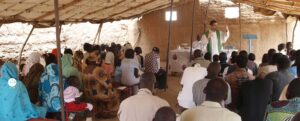
Although a minority, the Church has always been a “safe harbour” for the population and many people naturally fled to the churches at the start of the war. Now this refuge has itself become fragile. Many missionaries and religious communities have had to leave the country, and parishes, hospitals and schools have ceased their activities. The preparatory seminary of Khartoum, where students spend a year getting ready for their priestly formation, has had to close its doors. Fortunately, certain seminarians who managed to flee have been able to pursue their formation in the Diocese of Malakal in the neighbouring country of South Sudan.
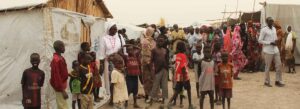
Archbishop Michael Didi of Khartoum was at Port Sudan, on the Red Sea coast, when the war broke out and has not been able to return to his city, and Bishop Tombe Trile, of the Diocese of El Obeid has had to move into the cathedral, because his house was partially destroyed. Many Christians have fled on foot or via the Nile and have settled in refugee camps where survival is a daily battle. Today the very existence of the Church in Sudan is called into question.
According to one of ACN’s project partners, however, there is still hope in the midst of the darkness. “Although it is true that the war continues, it cannot quench life. Sixteen new Christians were baptised in Port Sudan during the Easter Vigil and 34 adults were confirmed at Kosti!”
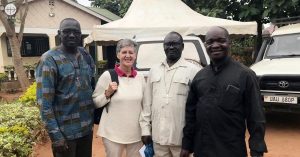
The Church also remains very active in South Sudan, assisting refugees from its northern neighbour and helping Sudanese seminarians to continue their formation, thanks to the support of ACN, among others. “Coming back from South Sudan, a country neighbouring Sudan and which shares the same bishops’ conference, I was amazed to see to what extent certain priests, who are refugees themselves, are using their energy to catechise in their new parish and to support other refugees. The Church in South Sudan is getting ready for the future by helping the Sudanese Christians to prepare for tomorrow’s peace”, Kinga Schierstadt concludes.
By Amélie Berthelin.

Recommended