Democratic Republic of the Congo: The people are well and truly on the Via Dolorosa!
Since the mid-1990s, entire areas of the Democratic Republic of the Congo, and particularly the eastern parts of the country, have been caught up in a never-ending nightmare: the people are well and truly on the Via Dolorosa! Just like Jesus on the Cross, the deeply devout people of the Democratic Republic of the Congo have every reason to call out to God in desperation: “My God, my God, why hast thou forsaken me?”
“Yes, in the case of the Democratic Republic of the Congo, one can really speak of a Via Dolorosa,” a contact person from the diocese of Butembo-Beni, who remains anonymous out of safety concerns, said to Aid to the Church in Need (ACN). “A climate of terror reigns in the diocese, which is maintained by the armed groups that have moved into the region since 1995.” The source emphasised that the situation is even worse in a number of parishes that are located in the region that journalists call the “triangle of death”. This concerns four parishes, “namely Eringeti, Mbau, Oicha and Buisegha in the commune of Beni. The parishes Kipese, Kagheri, Bingi and Luofu are located in the territory of Lubero. A number of residents of these parishes have spent more than twenty years constantly fleeing from one place to the next!”
The cause of this never-ending nightmare is the presence of rebel groups that have been slaughtering the population since 1995. “These massacres are taking place in the northern parts of the diocese of Butembo-Beni, or, to be more precise, in the commune of Beni as well as the environs of the city of Beni,” the source told ACN. “These massacres have now spread to the neighbouring province of Ituri, which is located in the northern part of our province of North Kivu.”
Among other groups, a Muslim guerrilla organisation that originated in Uganda and goes by the name of ADF-Nalu (Allied Democratic Forces) is responsible for the massacres. The rebels have been in the diocese since 1995. The contact person further reported that “analyses have shown that the manner in which the killings are being carried out is similar to that used during the Rwandan genocide in 1994.” This has convinced a number of observers that a “Rwandan mastermind” could be behind the massacres that have been terrorizing the people in the eastern part of the Democratic Republic of the Congo for more than 25 years.
“These villains use machetes and axes to mercilessly kill young and old people, women and children,” the informant said.
He also mentioned “a project for Balkanization” that is being promoted by unknown forces with the goal of literally creating a “Tutsiland” that would reach “over our entire province of North Kivu, across South Kivu and across the province of Ituri. These would then join Rwanda. That is the reason why the peaceful population is being massacred: to obliterate all traces of the indigenous peoples who are cultivating the land. This is what has turned these populations into a flood of refugees. We don’t know at which level the complicity [of the different state agencies] is happening – on a regional, national or even international level,” the informant continued.
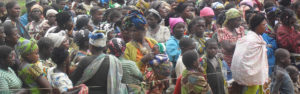
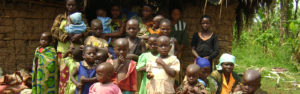
He also explained that the exploitation of natural resources and the control over these riches as well as “greed” also play a role in these massacres and have led thousands upon thousands of people to flee. According to estimates provided by Doctors without Borders, since December 2017, 50,000 people have crossed Lake Albert, a large lake in Ituri province, to escape the massacres, the raping of the women, children and old people and the destruction of their villages. They are finding shelter in Uganda on the other side of the lake.
How is it possible to proclaim the Gospel here?
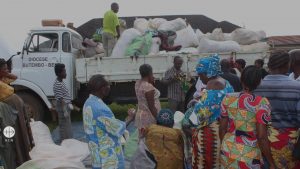
In the Democratic Republic of the Congo, the Church continues to be one of the strongest moral and social powers. “Our church in Butembo-Beni is working on sensitising the people so that the refugees are taken in by families,” the contact person explained. “The diocese has called for donations of money and goods (food, clothing, equipment) several times. However, the never-ending war has so impoverished the people that almost nothing is collected anymore in response to these calls for donations.”
The Church remains strong in spite of the atmosphere of terror and persecution under which it is suffering. The source explained that the passage in the Gospels “Love your enemies and pray for them which persecute you” (Mt. 5:44) helps the people keep going. He also made reference to a well-known biblical figure: Job. “We have taken as an example the tenacity and the witness in suffering as well as the perseverance and patience of Job.”

Recommended