Middle East: Holy Week begins under the sign of the cross
ACN expresses concern over Palm Sunday restrictions in Jerusalem, Syria and Gaza, and conveys its support for Christians in the Holy Land.
The international Catholic charity Aid to the Church in Need (ACN) expresses deep concern over events that took place during Palm Sunday celebrations on 29 March 2026 in Jerusalem, Gaza and Syria, where Christian communities marked the day amid tension, restrictions and insecurity.
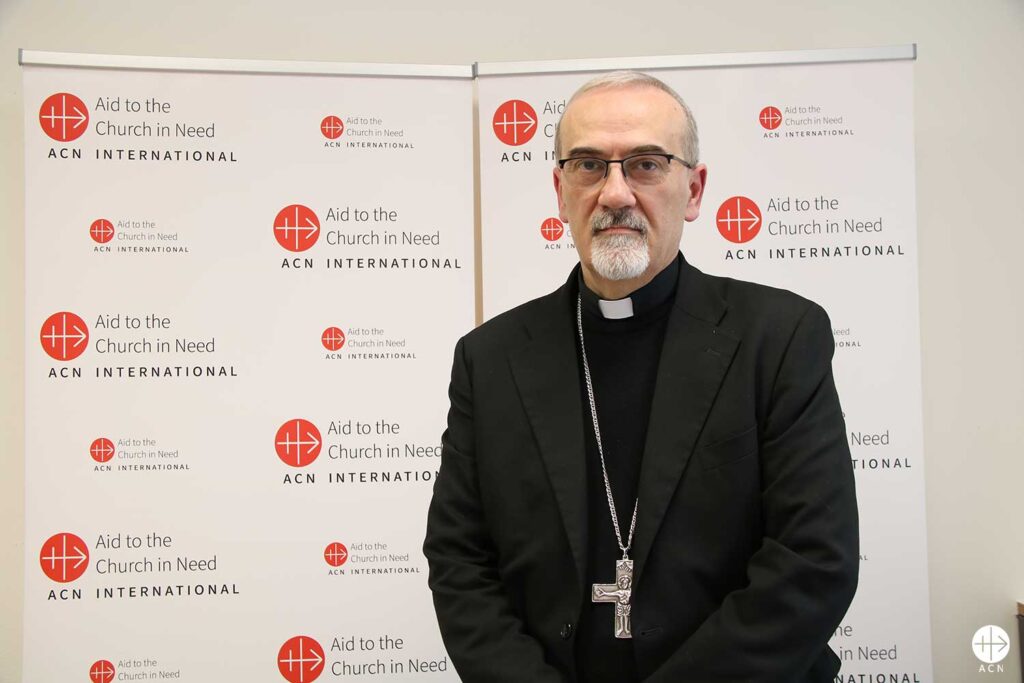
In Jerusalem, Israeli police prevented His Beatitude Cardinal Pierbattista Pizzaballa, Latin Patriarch of Jerusalem, as well as the Custos of the Holy Land, Fr Francesco Ielpo, from accessing the Church of the Holy Sepulchre, where they were due to preside over Palm Sunday Mass. The incident occurred on one of the most significant days in the Christian calendar and, according to local Church authorities, represents a serious limitation on freedom of worship in the Holy City.
This incident took place in a context already marked by the cancellation, for security reasons, of the traditional Palm Sunday procession on the Mount of Olives, heightening concern among the faithful and local Christian communities, whose presence in the Holy Land remains fragile.
At the same time, in Gaza, the Catholic parish experienced Palm Sunday under particularly difficult conditions. According to information received by ACN, the celebration took place in a tense atmosphere and during rain. “There was a lot of gunfire along the yellow line [the Israeli military limit established during the October 2025 ceasefire], and fragments of shrapnel landed on our roof,” Fr Gabriel Romanelli told ACN.
Due to the danger, and despite several attempts, the parish had to give up decorating the cross on the roof of the church with palm branches. The frame supporting it still bears visible marks of bombardments, but the cross itself remains intact, a powerful sign on the eve of Easter.
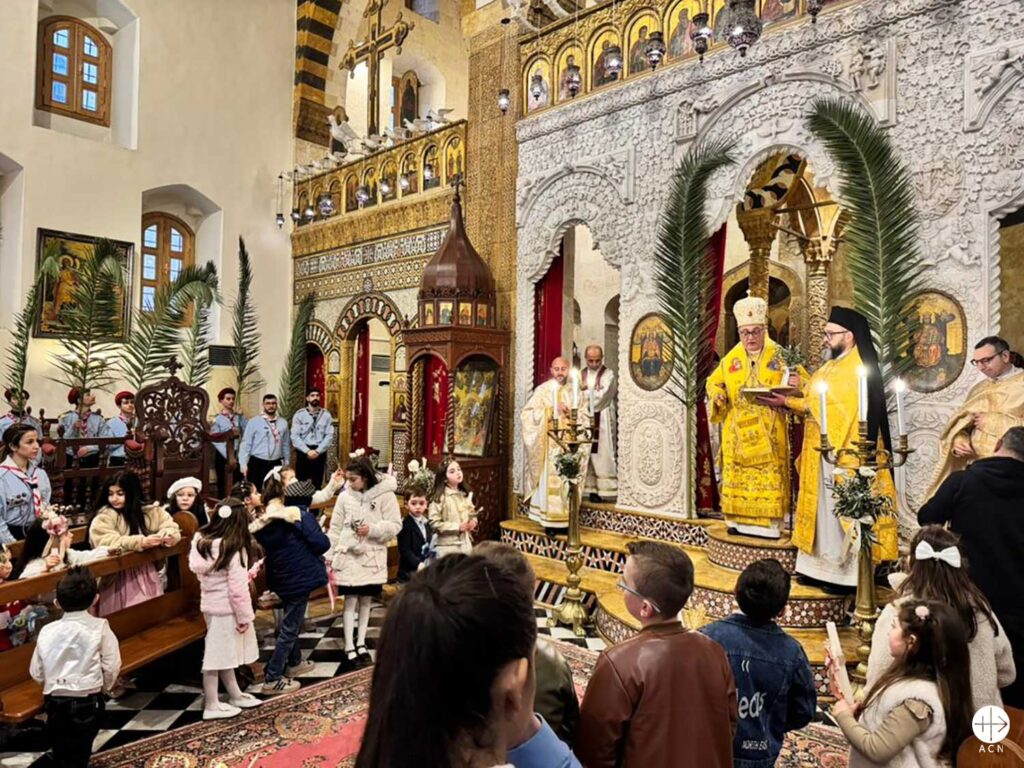
Concern among Christians also extends to Syria, where Palm Sunday processions were cancelled in several cities, including Damascus and Aleppo, due to ongoing insecurity and as a sign of solidarity following a recent attack on a Christian town. Liturgical celebrations took place inside churches in an atmosphere of caution and prayerfulness.
The attack on the town of Suqaylabiyah (Sqelbiyeh), in Hama province, occurred on the night of 28 March. According to local sources, residents of a neighbouring community attacked the town following a dispute. Several shops were looted and a statue of the Virgin Mary was destroyed. The situation was eventually brought under control, but the incident caused significant anxiety among the population, which is mostly composed of Christians.
Fr Dimitrios, a priest from Sqelbiyeh and an ACN project partner, told the charity that the attack was unexpected and that there had been no clear warning signs in the preceding days Although similar incidents had occurred in the past, they had been limited. According to the priest, incitement on social media influenced some young people and contributed to the escalation of tensions.
The priest also stressed that relations between different religious communities in the region generally remain good and that efforts are currently underway to contain the situation. “There is anxiety, tension and some fear today, but people have remained in their homes,” he said. He also explained that, for security reasons, outdoor Palm Sunday celebrations were cancelled, while Masses and prayers inside churches were set to continue as usual.
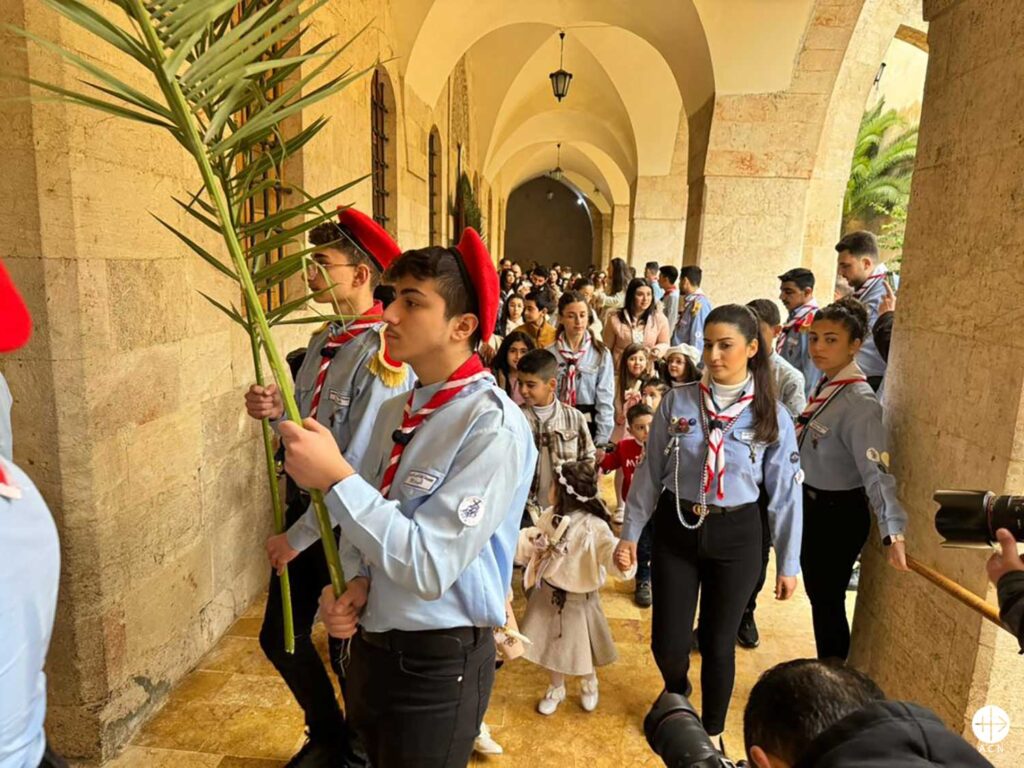
For his part, the Maronite Archbishop of Aleppo, Joseph Tobji, explained in his Palm Sunday homily that the cancellation of processions in Aleppo was not due to fear, but rather a deliberate gesture of solidarity with attacked communities. He said the decision was also a protest against the proliferation of weapons in the country and the presence of arms outside official government control.
Church leaders have repeatedly warned of growing concern among Christians about Syria’s future. Some Church leaders, including Archbishop Jacques Mourad, have pointed to increasing fears over the lack of freedoms and risk of marginalisation, fuelling concerns about a gradual Islamisation of society.
Meanwhile, in southern Lebanon, Christian communities held Palm Sunday processions despite the ongoing conflict and difficult weather conditions. In the rain and amid tension, following numerous attacks that caused the death of a Catholic priest and the forced evacuation of several Christian villages, the faithful took part in the celebrations, offering a testimony of faith and hope amid suffering.

In light of these developments, ACN expresses its closeness and solidarity with the Latin Patriarchate of Jerusalem, the Custody of the Holy Land and all affected Christian communities.
“We call for effective respect for religious freedom and the status quo regulating rights and access to the Holy Places in Jerusalem, so that the faithful may live their faith without obstacles, especially during these holy days,” said Regina Lynch, Executive President of ACN International.
“ACN also invites the faithful around the world to unite in prayer for Christians in the Holy Land and throughout the Middle East, and for peace in Jerusalem and across the region. May this Holy Week, marked by trial and uncertainty, also be a time of hope, reconciliation and faith in the Resurrection,” she concluded.

Recommended