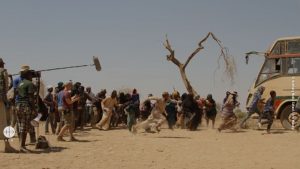
Ethiopia. “God is from every culture, from every clan.”
A documentary film supported by Aid to the Church in Need (ACN) about a missionary living with the Dassanech people on Ethiopia’s Omo River, who works to overcome generations of inter-tribal violence through evangelisation and reconciliation, was selected and nominated in the best documentary category for the 23rd Religion Today Film Festival in Trento (Italy). The festival took place from 23-30 September. The film was directed by Magdalena Wolnik, author of several dozen documentary films made in cooperation with Catholic Radio and Television Network (CRTN) and the pontifical foundation ACN. She has filmed in 16 countries, including Angola, Brazil, Cambodia, Indonesia, Myanmar and Pakistan.
Maria Lozano speaks to the Polish journalist and film maker about the film “Ethiopia – From every clan”.
How did you “find” the story to the film?
The first visit to Omorate led to the most terrible hours spent in Ethiopia. We went there with Bishop Tsegaye Keneni Derara from Soddo and Father Andrzej Halemba, who was then responsible for the pontifical foundation Aid to the Church in Need projects, supporting Church activities throughout the country. Getting to the Omo River valley, along the Kenya and South Sudan border, is not easy. A truly decent road was only recently built, but two years ago. We arrived at our destination in the evening, after many hours, and were put up in a small guesthouse, built by zealous young priests who had forgotten about ventilation, window netting or mosquito nets. Of course we did not expect electricity. Outside, apart from the mosquitoes, you would trample on scorpions on your way to bed, meet a few poisonous snakes, as well as hyenas keenly taking advantage of the lack of any fence. Forty degrees centigrade – even at night – no air, means no sleep. Hell on earth. Abba Goesh seemed to be profoundly convinced that God had sent him to this place and to the people inhabiting this land. It seemed impossible to live here without such a belief. After those first hours and conversations with him, I knew for certain that we would be back with a camera.
How was the filming? Was it difficult to get the people involved?
Once we began filming, things only got worse. If it wasn’t the heat, it would be a powerful downpour and sticky mud, with a multitude of scorpions emerging. If not a plague of insects – preventing you from opening your mouth – then a sandstorm, that instantly blanketed the entire landscape in brown dust. Our brand new sound recorder failed on the second day. The villagers were initially not very friendly. There, strangers are not allowed to enter your enclosure, much less your hut. We gained their trust in the end, but more on the back of that earned by Father Goesh. He was our gateway into this fascinating world of the Dassanech tribe. We felt privileged and grateful to be allowed insight with our camera, behind these people’s veil of inaccessibility, of an individuality and uniqueness they had a right to protect. In recent years more and more tourists have been coming to the Omo Valley, rich in “exotic tribes”. This meeting of two worlds is sometimes violent and destructive. So, we tried to be wholly respectful, humble and gentle.

Why this story?
This film, on the one hand, aims to show a unique ethnic group, which, while still living a very traditional lifestyle, and fighting bloody battles with local tribes, finds itself, very suddenly, on a collision course with change, including climate change with the inevitable drought and hunger that follows and needs a guide, capable of helping this group to confront and deal with this reality. Not only in material terms, including education, agriculture and the knowledge needed to survive in a changing world, but also in spiritual terms. How to stop waging destructive wars? Whom to entrust one’s life to?
Father Goesh, the priest, seems to play an important role in the community. Is that right?
One of the village chiefs spontaneously introduced Father Goesh, explaining who he is for them: “He told us how we can live with other neighbouring people. He taught us what peace means.” Whilst another added, “Father Goesh is our brother. He is a man of God. He taught us how to worship God.”
What do you want to tell people watching this film?
The Dassanech people are a beautiful, unspoiled and fascinating tribe. However, this is not an anthropological film. It is also Father Goesh Abraha’s story: an Ethiopian, from the mountainous north, who decides to live among these people. To live with them, share their concerns and convey to them a deeply held belief, that God is more than my and your culture and tradition, indeed than any great culture. That He can give freedom and peace to each one of us. That He is from every culture, from every clan. Father Goesh builds a chapel in the wilderness, believing that with time, the feuding clans and tribes will end up praying together. That it will become their church, with which they will identify themselves – a sign of peace, reconciliation and hope. He is also a happy man who says that you can learn to love a culture that is not yours, embrace and accept the unknown: smells, tastes, even the challenges of living in this seemingly unliveable place. And it changes you.
What was the most touching moment?
Omorate is the Acts of the Apostles lived today. Paul dreamed of a Macedonian man who asked: Cross over to us and help us. That is how the evangelization of Europe began. Father Goesh travelled through these lands, from Kenya to Adigrad, and met the Dassanech tribe, still battling with local tribes, with whom no one had dared enter into dialogue. He felt that he should try to live in this difficult land. Both were convinced that God was sending them to unknown lands and peoples, with whom they had to find a common language, in order to bring them the good news that also brings peace. Such places and such people beg us to ask ourselves: do we also have this ardour, anxiety, for those beyond the reach of the Gospel? And do we, who live in peace and comfort, care for people who continue to experience such great marginalization and poverty? Omorate provokes both delight and reflection. I hope our film does, too.

Recommended