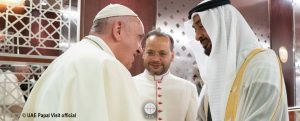
The Pope starts on Sunday a historic journey to the United Arab Emirates
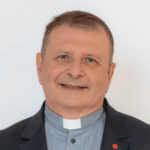
Bishop Paul Hinder is Apostolic Vicar for southern Arabia. As such, the Swiss Capuchin monk will host the pope when he sets out for Abu Dhabi in the United Arab Emirates this Sunday. Aid to the Church in Need spoke with him about tolerance in everyday life, a lack of religious freedom and the expectations for the papal visit.
Your Excellency, Pope Francis will soon be visiting Abu Dhabi. Would it be an exaggeration to speak of a historic visit?
No. The visit can be called historic for two reasons in particular: first of all, this will be the first time in church history that a pope will visit the Arab Peninsula. Second of all, it will be the first time that the Eucharist will be celebrated on public property that the government has placed at our disposal for this purpose.

You are expecting over 130 000 faithful, who will openly come together for the Papal Mass. That would be inconceivable in neighbouring Saudi Arabia. Churches do not even exist there. Why are things different in the United Arab Emirates?
How much freedom of worship is granted, that is, the possibility of celebrating divine services as a congregation, varies in each of the countries of the Arab world. While in Saudi Arabia divine services are only tolerated when held in private in relatively small groups, in other countries, particularly here in the United Arab Emirates, churches have been built and are visited by thousands of worshipers each week, even daily, to celebrate mass. This freedom to celebrate divine services usually depends upon the openness and tolerance of the respective rulers. Over the last few decades, this could be found particularly in Bahrain and the United Arab Emirates as well as Oman.
So the rulers of the United Arab Emirates have a relatively open attitude towards Christians. Is this shared by the general population?
I have been living in Abu Dhabi for the last 15 years and have never experienced any animosity. Of course we know that in all Islamic countries, non-Muslims – not only Christians – have to comply with the social laws of Islam. On the other hand, I see a deep respect for Christians, also among the local population. This is even more apparent now in the run-up to the papal visit.
How?
A number of Muslims have contacted me to ask how they can help prepare for the visit. Many have expressed an interest in attending the Mass. The government is also doing everything in its power to ensure that as many of our faithful as possible will be able to see the pope.
Does this willingness to help also have something to do with the popularity of Pope Francis?
The reactions of the Muslim population to the election of Cardinal Jorge Bergoglio as Pope Francis were only positive. This is also evident right now. Since the announcement of his visit was made, I have only noticed signs of joy and pride that the pope is coming to the Emirates.
What made this visit possible?
There are various reasons for this visit. Over the past few years, a number of different invitations were sent to the pope from all over the region, including the UAE. The local church also communicated its desire to have the pope stop over here.
The church in the Emirates is made up of only foreigners, in particular foreign workers. What kind of problems do you face as bishop because of this?
One of the critical pastoral problems lies in strengthening our people in their faith and encouraging them to bravely retain their Christian and Catholic identity and profess to the faith even in an environment that does not always make this easy. I am thinking about the domestic workers and construction workers who not only have to work hard each day, but sometimes also have to deal with the missionary zeal of Muslim employers or colleagues.
What happens when a local Muslim wants to convert to Christianity?
I am not aware of any Muslim country that allows full religious freedom. Even in those where converting a Muslim to another religion is not punishable by law, at the very least the person’s social circle, in particular his or her family, will react with ostracism or even physical violence. As I said already, freedom of religion is greater or lesser depending upon the country.
Do you have enough churches and priests?
More churches would be desirable, as the number of our parishes is still not commensurate with the number of believers. In the United Arab Emirates, for example, we have nine parishes, which is definitely not enough for the almost one million Catholics living in the country. Furthermore, it also needs to be taken into consideration that, in contrast to the other churches, our members are international, speak different languages and follow different Catholic rites. A further pastoral challenge arises from the fact that, due to their situations as migrants, many of our faithful are facing moral issues that they would never have believed they would have to deal with. This is particularly common among those men and women who live apart from their spouses because of work, often for periods longer than a year. It is not uncommon for marriages to break up when they begin new, “temporary” relationships.

How can the papal visit help to improve the situation of Christians in the Islamic world?
I hope that the visit of the pope will be able to change the overall mood for the better. However, it would be a mistake to expect too many miracles from this kind of visit. The decisive thing is that we Christians are credible witnesses of the message of Christ. And that also means accepting with humility that we will never play first fiddle in this society. It is sometimes enough to be able to play a simple recorder with sufficient proficiency to delight others!
Therefore, it may very well be that the papal visit will result in little more than a shared cup of coffee and pretty pictures?
It remains to be seen if the visit will leave any kind of lasting impression. In English we say that one swallow does not make a summer. A dialogue with another religion and its representatives takes time and patience and setbacks are unavoidable. This is also true for ecumenism within Christianity. Even if all that is achieved is greater mutual respect and this makes it possible to work together in problem areas that affect all the religions, then progress has been made. You only need to think about the challenges in the commitment to peace or in the care for our common home of creation.

Recommended