Myanmar: “I fear there is going to be a bloodbath”
Expert talks about the motives behind the military coup
The future of the democratic process in Myanmar lies in the balance. In the early hours of 1 February the military of the former Burma once again seized power by coup. The armed forces have declared a one-year state of emergency in the country in Southeast Asia. However, this time the situation is different: the people are refusing to accept the coup. The people of Myanmar have taken to the streets in large numbers in protest and a general strike has been called. Aid to the Church in Need (ACN) spoke with Angela Jacobi, director of the Dr Michael & Angela Jacobi Foundation, which supports numerous projects in Myanmar. The interview was conducted by Volker Niggewöhner.
What do you know about the current situation in Myanmar?
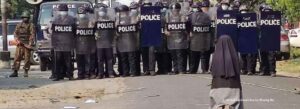
Not only tens of thousands, but hundreds of thousands of people have taken to the streets. It is the first time that entire professional groups such as physicians, rail and airport workers have joined in the protests – even police officers. That is dangerous for the generals. After all, without the support of the police force the coup may fail. But what can the people do against tanks? And tanks are now being deployed everywhere.
Are you still able to communicate with your contacts in Myanmar? It is said that internet connections have been cut off.
Astonishingly enough, I still have contact with two religious brothers. They write that the situation is “very, very serious”. The last message arrived from the northern part of the country, where many refugee camps are located and there is frequent unrest. They report, “The army is now firing on unarmed civilians.”
Claims of election fraud are the official reason for the coup. Is there any truth to these claims?
In my opinion, this is only the ostensible reason. Cardinal Bo confirmed this on 3 February in a message addressed to the conflicting parties and the international community. International observers were there, the problem could have been discussed directly and immediately. The elections were on 8 November and to suddenly appear on 1 February and claim voter fraud – that is so obvious that nothing more needs to be said.

What could then be the real motivation behind the coup?
In my opinion, Aung San Suu Kyi and her party have always been a thorn in the military’s side, and now they have celebrated a second landslide victory over the military. However, again it is a farce because three-quarters of the parliamentary seats are held by the military even though Aung San Suu Kyi won more than 80 per cent of the votes.
The problem is that all of the raw materials – mines and specifically the three largest industrial conglomerates in the country – are in the hands of the military. Now that Aung San Suu Kyi has again won a clear victory in the election they feel as though they are losing control.
What is your assessment of the democratic process over the last few years?
From the beginning, the hands of the governing party NLD were tied. If three out of four seats are held by the military, then there isn’t much you can do, no matter how hard you try. However, in spite of everything, the most important thing for the people was that they still had hope in democracy. A lot of good developed out of this hope. There are a lot of positive initiatives, for example in education. This is now all up in the air again.
What role does nationalism play in Myanmar?
Unfortunately, nationalism plays a very important role. This is evident in the fact that ultranationalist monks played a more significant role in the coup than I ever would have imagined. I already noticed during the Rohingya crisis that there is a strong desire and ambition to transform Myanmar into a purely Buddhist state.
Will this coup have consequences for Christians and other religious minorities?
I am afraid so. We saw how quickly the Muslims were almost completely ousted. I am very concerned that this may be the start of large-scale persecution of Christians.
The coup happened about three months after the election, which means that it cannot be explained away as an impulsive act. Is this evidence that foreign powers may also be involved?
The involvement of China is being discussed quite openly by the media in Myanmar. Due to its many natural resources the country is the treasure trove of Asia. My travels have taught me that the Chinese would like to own Myanmar.
In his letter dated 3 February Cardinal Bo said, “We are journeying through the most challenging times of our history.” What should the international community do now in your opinion?
There is no easy answer. There certainly shouldn’t be any sanctions, because this would only weaken the people even more. My greatest hope lies in the people themselves. But I can’t say how long the people will be able to hold out. I fear there is going to be a bloodbath. The military is merciless because every move seems to have been planned well in advance.

Recommended