Melkite Catholic Patriarch Youssef Absi: “The reconstruction of this cathedral symbolizes the hope in our hearts and it is a sign of us overcoming despair and death”
[vc_row][vc_column][vc_column_text]The Melkite Catholics of Homs will be celebrating their first Christmas in the Cathedral of Our Lady of Peace since the liberation of the city
Nevertheless, the peace is still not entirely stable in the city of Homs where only last Tuesday a bomb exploded on a bus, killing six people and wounding another eight.
The re-consecration of the altar in the Cathedral of Our Lady Queen of Peace on Friday, 1 December was a new milestone on the journey back to normality in the city of Homs. At one time the centre of the war in Syria, the city was for three years – from 2011 to 2014 – the scene of innumerable bombings and fierce fighting which left the city utterly devastated.
During his emotional homily in the course of the ceremony, the Melkite Catholic Patriarch Youssef (Joseph) Absi made reference to the interminable sufferings of the people of Homs during this time. “Many have fallen as martyrs, your homes were destroyed, you were forced to displace and lost your belongings and money, but, nevertheless, you did not allow these hardships to overcome you and defeat your spirit. You came back, with your strong will, to rebuild what has been destroyed, and here, today, you, with your presence, bring life back to this cathedral”, he told the people attending worship.
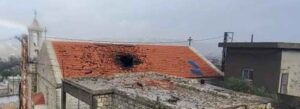
The Melkite Catholic cathedral was the most extensively damaged church in the whole of Homs. The cathedral and all the property of the diocese were in rebel hands until 9 May 2014. The bombs and bullets left their mark on the cathedral and it roof, and many of the icons and statues were stolen or disfigured. Marble columns lay in ruins and other objects were burned with fire. In the crypt they profaned the tombs of the priests.
“Two days after the liberation of Homs there was an enormous explosion inside the cathedral, causing damage that was ten times worse. The cupola, the roof and two entire walls collapsed. The rebels had hidden explosives beneath the bishop’s cathedra, the throne where the bishop sits”, explained Melkite Catholic Archbishop Jean-Abdo Arbach of Homs to the communication department of the international Catholic pastoral charity and pontifical foundation Aid to the Church in Need (ACN).
The hell may have passed in Homs, but the peace is far from stable yet. On Tuesday, 5 December an explosion in a bus left six people dead and eight wounded. Nevertheless, Archbishop Arbach said to ACN, “the people are accustomed to suffering and therefore, despite all the difficulties, they keep going. Of course there is still some fear, and some of them are still thinking of emigrating from the country. But the situation outside is not easy either and many people are returning and have begun to rebuild their homes. The government has been busy restoring the electricity supply and cleaning up the streets…” And so, while the peace may not be entirely stable, still worse was the situation of violence and destruction that prevailed beforehand. The archbishop added that “most of the people want to return to their homes”. Leading by example, the Archbishop himself was one of the first to return to his seat and work from there, thereby giving confidence in the sense of security to his faithful, who have also begun to return.
In this context, as Patriarch Youssef emphasized in his homily, the re-consecration of the altar in the cathedral is a highly important symbol. “Rebuilding the churches and restoring them is meaningless without your return to them; without the reconstruction and rebuilding of man”, he told them. “Today, we not only celebrate the reconstruction of this church, but also celebrate our will to stay here, in our land and country. The reconstruction of this cathedral symbolizes the hope in our hearts and it is a sign of us overcoming despair and death.”
During the celebration, which was attended by over a thousand Catholic faithful as well as by representatives of other Christian denominations and also by representatives of the Muslim community, the Melkite patriarch underlined the importance of hope, referring to the gospel of the day and the parable of the Good Shepherd: “The conclusion of Jesus’ saying is that he does not leave us prey to evil or to death, the representatives of the werewolf in all their forms, but rather to defend us, to protect us, to guard us even at the expense of his life. It may be hard for us to believe this in the sea of hardships that have beset us and are still, but Jesus insists on us not to lose hope. We are asked to trust, not to be afraid.”
And so, while the celebration was an important milestone on the road reconstruction, it is not the final destination. In the words of Archbishop Jean Abdo there is still much to do: “The rebels shot up the icons on the walls, and we still have to restore these. We also have no benches in the church and we still have to rebuild the iconostasis of the altar. And there is much work to do to finish the exterior walls.” Though he adds optimistically, “But we have completed the central nave and so this year we can celebrate Christmas inside the cathedral for the first time. And we are also going to organise a Christmas concert on 16 December with Catholic, Orthodox, Protestant and Muslim choirs.”
The Archbishop reiterated his gratitude to the benefactors of ACN for the great support they have given to the diocese of Homs over the past few years, during which the pontifical foundation has supported no fewer than 37 projects – among them the reconstruction of the cathedral – since the beginning of the conflict. “First of all, I give thanks to God for giving us the strength to continue our work, and secondly I wish to thank Our Lady of Peace for having saved us from so many dangers, and finally I wish to thank ACN and its benefactors throughout the world. With your support we have been able to rebuild our souls, rebuild our community and rebuild our country too, for Syria is a country of profound Christian culture. We have churches and saints dating back to the earliest years of Christianity. There are at least eight popes who were Syrians. We pray every day for the benefactors of ACN. May God bless them, each and every one of them and reward them a hundredfold, as the Bible says. And now that we are about to celebrate Christmas, I pray to the Child Jesus that he may bring peace to our families and to our country – and also to all those who are supporting us. May God bless you all and the Virgin Mary protect you!”[/vc_column_text][/vc_column][/vc_row]

Recommended