Jerusalem: background to the closure of the church of the Holy Sepulchre
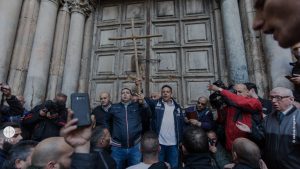
Yesterday (Wednesday) the Church of the Holy Sepulchre in Jerusalem reopened its doors. Last Sunday the Catholic, Greek Orthodox and Armenian Church representatives had jointly decided to close this sacred building indefinitely, in protest against two controversial Israeli actions. In the interview below, Maria Lozano of the international Catholic pastoral charity Aid to the Church in Need (ACN) spoke about the background to the controversy with Andrea Krogmann, the correspondent of the German Catholic News Agency KNA, who has been reporting for years on the situation in the Holy Land.
What can you tell us about the decision to close the Church of the Holy Sepulchre? Was this church ever closed for political reasons before?
This is not the first time the church has been closed in this way. At least once before there was a closure, and on that occasion it was in connection with the intifada, in solidarity with the Muslims – at least, according to the custodians of the keys, who are traditionally Muslims, and certain individual Church representatives. However, it is a most unusual step and also a relatively drastic one.
The protest by the Church leaders was addressed against what was described as a „systematic campaign“ against the Christian communities in the Holy Land and a „blatant breach of the existing status quo“. How are we to understand this? What exactly is behind it?
According to the traditional status quo dating back to Ottoman times, the Churches are exempt from taxes. Now Israel has for a long time been attempting to change this. At the back of it is the question as to why the commercial enterprises of the Churches should also be excluded from property taxes. So it is not about the churches and places of worship themselves, but about the Church-run facilities such as guesthouses and schools, which Israel is striving to make subject to a property tax. The Churches are resisting these attempts and pointing to the centuries-old traditional status quo agreements. Moreover, the Catholic Church is reminding people about the decades-long, ongoing negotiations between Israel and the Vatican that are aimed among other things at clarifying these very questions.
So why has the whole business suddenly escalated in this way?
Because the Jerusalem city authorities have recently taken concrete steps to enforce these taxes on the Churches, including freezing Church bank accounts among other things.
This is one aspect of the background to the protests by the Churches. However, the other background is the proposed legislation that is currently under discussion in Parliament. What is this about?
The proposed law is intended to allow the state of Israel to confiscate land sold by the Churches to private investors, and indeed with retroactive effect. The background to this is the fact that in some particular suburbs of Jerusalem a great many apartment blocks have been built on land leased or sold by the Church – more specifically, by the Greek Orthodox Church. There are people living on this land who, as a result of the sales, now find themselves in an insecure situation. According to its initiators, the proposed law is aimed at protecting these people. However, the Church sees it as a form of discrimination – for if land sold by the Church can later be confiscated, then no one will wish to purchase such land in the future, since the risk is too great.
How is this going to be resolved? The latest news indicates that there has been some degree of rapprochement between the two sides…
Franciscan Father Francesco Patton of the Custody of the Holy See has said in an interview with the French newspaper „Le Figaro“ that the Churches are looking for a signal from the authorities. Yesterday Israeli Prime Minister Benjamin Netanyahu agreed with the Mayor of Jerusalem to establish a working party on the Israeli side to work out a compromise and negotiate with the Churches. As part of this agreement between Netanyahu and Jerusalem‘s Mayor Nir Barkat, it has been decided that for now the city will renounce any further tax demands, or in other words suspend its current measures, and that for the time being no further legislation will be considered in regard to Church property.
The Churches have immediately responded to this and Wednesday morning the Church of the Holy Sepulchre was once again reopened. This is the current state of affairs.
We are now approaching Holy Week and the feast of Easter. What is the general mood among the pilgrims and others visiting the Holy Places?
Many groups of pilgrims are already travelling, regardless of the closure of the Church of the Holy Sepulchre and the controversy surrounding it. Statistics from last year and also from the first few months of this year indicate that the number of people visiting the country is increasing. The atmosphere is pretty relaxed. Pilgrims continue to arrive, and in considerable numbers. The guest houses are pretty much fully booked, though there are some surprising exceptions. For example the „Notre Dame“ hostel – a very famous pilgrim hostel in the centre of the Old City – is still not fully booked for the Easter week. But generally speaking, the atmosphere is good and things are busy in the city.

Recommended