Istanbul: Could the former cathedral of Hagia Sophia become a mosque?
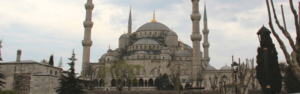
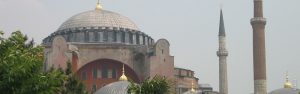
The great cathedral of Hagia Sophia in Istanbul, Turkey, was once the centre of Eastern Orthodoxy, before being transformed into a mosque, and then a museum. On 23 March this year the Muslim call to prayer was once again heard in this former byzantine cathedral, a building which has been officially secular since 1934. The first time that such an event happened in recent history was on 3 July 2016, after an interval of 85 years.
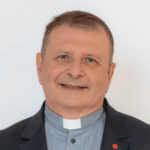
In order to decipher the motivation behind this incident, the international Catholic pastoral charity and pontifical foundation Aid to the Church in Need (ACN International) spoke to Etienne Copeaux, a historian of modern Turkey. As a former fellow of the French Institute of Anatolian studies (Institut français d’études anatoliennes) in Istanbul and a former researcher of the CNRS (Centre national de la recherche scientifique), he currently hosts the blog Susam-Sosak, which is devoted entirely to Turkey. He was interviewed by Christophe Lafontaine.
How do you explain the demand by Muslims to be allowed to pray in Hagia Sophia in Istanbul?
The demand for the return of this sixth century Basilica to a place of Islamic worship has been strong ever since the 500th anniversary of the fall of Constantinople in 1453. When the city was captured by the Muslim forces (the “Fetih“), the Sultan went to the cathedral to celebrate his victory, thereby transforming it ipso facto into a mosque. This gesture was considered as conferring a sacred and Islamic character to the basilica, which has since become a symbol of Turkish Islam – even though, paradoxically, it is still called by its former Greek and Christian name of Hagia Sophia. Kamal Atatürk, the founder and first president of the Turkish Republic (from 1923 to 1938), decided in 1934 to “secularise” the cathedral – thereby greatly scandalising religious Muslims – and transform it into a museum, which is what it remains to this day.

So is the issue of Islamic prayer inside Hagia Sophia a question of rejecting the secular society envisaged by Atatürk?
The commemoration in 1953, which was initially modest enough, occurred during an anti-secularist period, a time that saw a return to the religious dimension under the government of the democratic party of Adnan Menderes (1950-1960), who in 1956, in Konya, declared: “The Turkish nation is Muslim”. This declaration in fact reflected the character of Turkey, which had by then become de facto 99% Muslim, following the genocide of the Armenians, the expulsions of the Greek Orthodox and the pogroms against the Jews, and it has since become the slogan of choice for the Turkish extreme right.
When political Islam was returned to power, from June 1996 to June 1997, the then Prime Minister Necmettin Erbakan promised those who voted for him that the basilica would be returned to Islam. However, he did not remain in power long enough to accomplish this project. But during approximately the same era, from 1994 to 1998, Recep Tayyip Erdogan was mayor of Istanbul, and he made the same promises. But he was deposed by the Army in 1998 and even spent some time in prison for “undermining the secularism” of Turkey.
In 2018, Erdogan, now as Turkish president, recited the first verse of the Quran inside Hagia Sophia, and in March 2019 he declared his wish to change its status from that of a museum into a mosque. Should this be linked to the call to prayer on 23 March this year?
I believe that many of the measures taken by Erdogan, from 2002 onwards and particularly in 2012, were both in pursuit of a political objective dating back over 50 years and at the same time revenge for the injury of being deposed in 1998. And so the prayer in March this year was in my view no more than the continuation (modest for the time being) of a long process. Above all we should not see the Erdogan regime as a rupture, for it is the result of a long nationalist and Islamic trend, which has not always been an underground one.
How might the Christians of Turkey react?
The “Christian people” of Turkey – and above all the remnant of the Orthodox population, the great majority of whom were expelled in a series of waves, in 1914, then in 1955 and 1964 (to say nothing of the expulsion of the Orthodox from northern Cyprus in 1974) – are extremely cautious, given what they have been through. Indeed, the constant exhortations to be careful are even repeated insistently by the religious authorities: don’t make waves, don’t ever complain… The reactions of the Orthodox Christians of Turkey can only be made via the official channels of the Ecumenical Patriarchate of Constantinople. But as experience has shown, the encounters between the Patriarch and the Turkish authorities are often very formal, very diplomatic.
But would the Orthodox world from the Greece to Russia remain equally passive if the basilica was turned over to Muslim worship, as it was in 1453? Given the present context of complicated relations with Russia in regard to Syria, this is pretty unlikely.

Recommended