Bulgaria: Breaking the vicious cycle for Romani children
[vc_row][vc_column][vc_column_text]“If we don’t do anything, the fate of the Romani children will be sealed,” Salesian Father Martin Jilek from Stara Zagora in Central Bulgaria, 230 kilometres to the east of the capital of Sofia, said. “They are married off by their clan when they are fourteen. Then they have children early on and live off of the child benefit, which is about 40 leva per month and child.” That is equivalent to about 20 euros – the only source of income of many Romani families.
Around 28,000 Roma live in Stara Zagora, most of these children and adolescents. They live in shacks, run-down houses or the shells of unfinished buildings. In Bulgaria, around a million people are said to belong to the Romani people. No exact numbers are known. They live in a parallel society. Clan structures are opaque to those on the outside. The Romani people are despised, hated and banned from public life.
The resentment is so great that even Bulgarians who have a slightly darker skin tone and thus look like the Roma have a hard time getting jobs. The Roma generally only achieve a rudimentary level of education, if any at all. They do not receive any apprenticeship training. For this reason, many Roma fall into unemployment and a life of petty crime. This in turn strengthens the clichés and creates even more obstacles. The only source of income that remains is the child benefit. Children as a “life insurance policy” – and another step towards complete impoverishment: it is a vicious cycle.
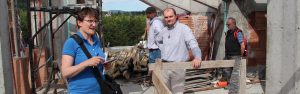
Father Martin and his confrères are not content to leave things as they are. With the support of the international charity Aid to the Church in Need (ACN), they have established a branch right in the middle of the Romani district and want to offer them better opportunities. Father Martin knows just how this can be done: “This is only possible through the children. The adults are practically inaccessible.”
“For many it already comes as a surprise when we address them by their names”
The Salesians have, for example, set up a kind of after-school homework programme – which offers so much more. The children come after school, eat together, play and learn. Elementary rules of etiquette are also taught to them there. “When the children have been with us for a few weeks,” Father Martin said, “they start saying ‘please’ and ‘thank you’. They also calm down and stop being so hyper.” Many don’t get any attention at home from their parents. They roam the streets, are avoided by other pupils. “For many it already comes as a surprise when we address them by their names,” Father Martin said. “We take time for the children. The parents are quick to find out about it, and they then suddenly turn up here as well.”
The workday never ends for the Salesians of Stara Zagora.
In their monastery, Roma people come and go at all hours. They come to attend Holy Mass, carry out small everyday tasks, seek advice or just pay a visit. And the Salesians want to do a lot more. A food bank is also planned. “This will give us the opportunity to talk to the people. We want to convince them to send their children to our school.”
This, however, is the main problem: many parents do not allow their children to receive a higher level of education than primary school. Because if they did, they would not be able to marry them off immediately. “It is hard work to convince the parents that it is better to have completed training or even have a university degree than to just draw child benefit,” Father Martin said. However, the first successes have already been achieved. “Many Roma now know us and understand that we mean them no harm.”
This is an example of the impact of one the projects supported by ACN: the construction of the church and the spiritual center of the Salesians in the Roma settlement in Stara Zagora. Currently, ACN is looking for donations for another project in Bulgaria: the renovation of the parish “Sacred Heart of Jesus“ in Rakovski.
[/vc_column_text][/vc_column][/vc_row]

Recommended