Home » News » Sri Lanka: The terror attacks have hurt people of all faiths

Sri Lanka: The terror attacks have hurt people of all faiths

Many Buddhists on the island also admire the Catholics for their peaceful, non-violent reaction

“The people here are good, but the government is bad”. This was the opinion expressed by one Buddhist taxi driver. And his view is one widely held in Sri Lanka today. Ever since it became public knowledge that the political authorities had already been warned, on 4 April, by India’s Secret Service about the planned terrorist attacks – which three weeks later, on Easter Sunday, claimed the lives of almost 300 people – the sense of outrage and indignation against the government has been intense. And not only among the Catholic victims and their loved ones. Among the Buddhists there has even been a suggestion that Cardinal Malcolm Ranjith, the head of the Catholics on the island, should be elected as president, some priests tell us, with a wry smile.

The feared revenge attacks did not materialise – not least because Cardinal Ranjith hastened to the scene of the terror bombings and urged his shaken and traumatised Catholics to renounce any form of reprisal.

Altogether around 300 people died. Not even the body parts have all been accurately identified, or all the victims buried, nor are all the critically injured even out of danger yet. The stories of the survivors are harrowing: Priyantha Jayakody, for example, lives in the mainly Catholic fishing village of Negombo. His wife was murdered by the Islamist suicide bomber on the morning of Easter Sunday, while his 17-year-old son only just survived. In all, the Muslim terrorist who struck in St Sebastian’s church in Negombo took the lives of 115 people.

Sri Lanka: The terror attacks have hurt people of all faiths.

Yet although the carefully planned bombing campaign by the terrorists was clearly targeted against Christians, the terror killings in fact claimed the lives of Buddhists, Hindus and Muslims as well. For the church of St Anthony, in the capital city Colombo, is a national shrine that is visited by members of all faiths. And St Anthony’s shrine is particularly attractive to families of mixed religion and to those contemplating baptism. For example, people like 38-year-old Sayana, a Buddhist, who has been interested in Christianity ever since she attended a Catholic school. After a long fast – a practice also very common among Catholics during Holy Week – she had come to St Anthony’s shrine early in the morning of Easter Sunday. She was just lighting a candle when the suicide bomber detonated his bomb. Fortunately, there was a massive column between her and the terrorist, and she survived with no more than damage to her hearing. But 54 people died in that moment.

Maiar Mar also had a terrifying experience. Heavily pregnant, she was trampled on by people fleeing in their panic. For many hours afterwards she lived in fear for the life of the child within her. Fortunately, her baby survived, but her sister-in-law did not. Velu Ranjithkumar, a Hindu, lost his Catholic wife in the attack, while a young Hindu family lost their 28-year-old father who, after a long fast, had gone to visit St Anthony’s shrine. Another young woman, a former Hindu who had converted two years earlier, lost her Catholic husband and is now alone with her little baby.

Rizwan Manju and Mohamed Yaseen lost their 15-year-old son in the attack on the church. “Our Imam came to the funeral”, explains the Muslim father, who frequently accompanies his Catholic wife to the church, though he himself has no intention of converting.

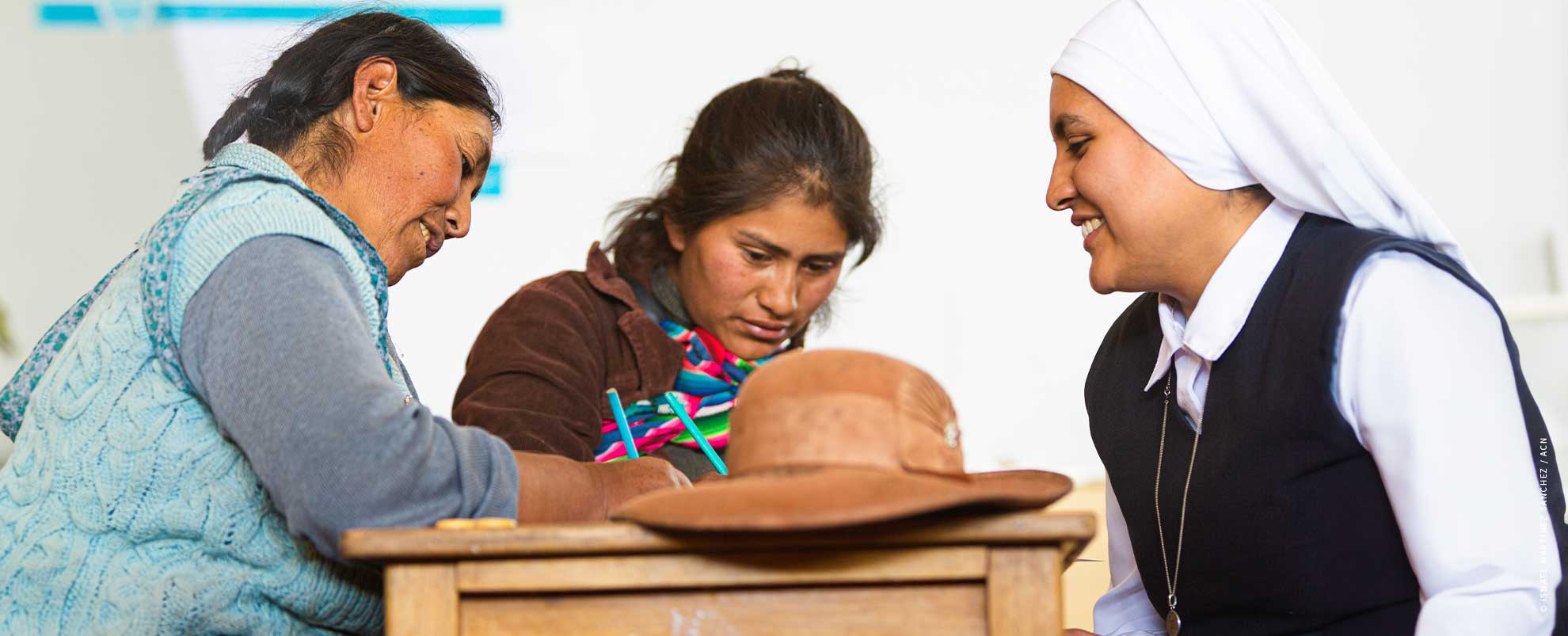
Sister Remoshini visits them all, translating from Sinhalese or Tamil as the occasion requires and bringing little sweets and treats for the children. Like many other religious sisters and priests, she acts as a bridge, enabling people to access the material, pastoral and psychological support offered by the Church and at the same time – as is immediately evident during her visits to the homes of the victims and victims’ families – offering a strong shoulder on which many weep .

22-year-old Medha and her 19-year-old brother Imash also died in St Anthony’s church on Easter Sunday. Their father is Buddhist, their mother Catholic. Tearfully, she shows us two handcrafted crosses that were made by her children. She no longer has any trust in the politicians. But she tells us that she has had frequent visits from the priests and religious sisters to comfort her in her grief. Like so many other victims and relatives, she has heard many promises from the government, but received no practical, financial support except from the Catholic Church.

Many Buddhists on the island also admire the Catholics for their peaceful, non-violent reaction.

Caritas is providing immediate emergency aid and paying for medical treatment and for the care of the newly orphaned – regardless of religious belief. And teams of priests are also offering spiritual and psychological support to the victims, listening to them in their pain and helping them to overcome their trauma. Many of these victims in fact find it easier to open up to others, outside their own homes. This is one of the reasons for the existence of the Church-run Emmaus Centre in Negombo. Here, married couple Kamilla and Thomas de Silva can put them in touch with qualified  therapists and offer spiritual counselling sessions, and they also spend many hours with them, sitting silently and praying in the adoration chapel.

But these are not the only reasons why respect for the Catholic Church in Sri Lanka has risen so greatly among the majority Buddhist population since Easter. What these Buddhists admire above all is the fact that there were no reprisals or revenge attacks but that instead the Catholics have responded peacefully, despite the terrible trauma they have suffered. “Let us bring our sufferings to the foot of the Cross, to the Eucharist. We have to forgive!” So says Father Claude Nonis, who is there to support all the traumatised victims, along with 80 trained psychological counsellors. And Jude Raj Fernando, the administrator of St Anthony’s shrine, adds: “Our God is not a God of revenge, but of love and mercy.”

Don't miss the latest updates!

Significant drop in arrests of priests in 2025 but deaths increase

The number of kidnappings also dropped slightly compared to 2024…

Christians call for peace and prayers as violence returns to Aleppo

Civilians are once again the main victims as the Kurdish-led…

Nigeria: A decade of terror for Catholic priests

New data highlights scale of priest kidnappings amid Nigeria’s security…

Gaza prepares for a Christmas without peace, but not without hope

As Christmas approaches, the priest of the only Catholic parish…

Burkina Faso: In the north, faith resists amid heavy international silence

The Church in northern Burkina Faso deplores the lack of…

Nigeria: 99 children freed reunite with their parents while 154 remain in captivity

Securing the release of the remaining students and staff remains…

Nigerian bishop on school kidnappings: “Our hearts are broken, but our faith remains firm”

“Evil will never win,” said Nigeria’s National Security Advisor, during…

List of News

Pope Leo XIV echoes Cuban bishops’ warning that fuel blockade could cause “chaos and social violence”

“Cuba needs reforms, and these are increasingly urgent, but what it does not need is more anguish and pain. No more loss of life or mourning within Cuban families,” say...

Significant drop in arrests of priests in 2025 but deaths increase

The number of kidnappings also dropped slightly compared to 2024 but remains a major problem in parts of Africa. Fewer priests were arrested or kidnapped in 2025 compared to 2024,...

As life returns to normal in Aleppo, trauma lingers and fear remains

ACN is committed to helping rebuild homes and lives of the Christian community in Syria. Violence in Aleppo, Syria’s second most important city, has subsided following the withdrawal of forces...