Life asserts itself again in Aleppo
[vc_row][vc_column][vc_column_text]
A larger group of Christian university students form a real family in the shadows of war
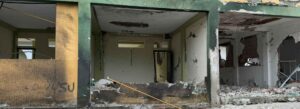
The city district Sahbat Al-Jadida in the western part of Aleppo was hard hit by attacks and bombings during the last five years of the war in Syria. Today, several months after the end of combat operations in the city, the situation is slowly improving in this area. During the day, the streets are vibrantly alive and masses of young people throng the pavement. The large university campus is also located in this district. “I did not want to go to Aleppo. My family also did not want me studying here. But this is where I was accepted. For three months, my father insisted that I should not do this. But I did not give in and he finally let me go,” young Angel Samoun, an aeronautical engineering student, says. She comes from Qamishli in the Kurdish region of Syria, which is now under the control of local Kurdish militias.
Aleppo was also not the first choice of student Lara Lias. She comes from Daara, a city in the southern part of Syria, which became famous through the demonstrations that ultimately led to civil war. “I was very afraid because I was so far away from my parent’s home. When I came here, my family said good-bye to me as though I were dying.”
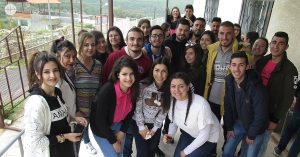
Despite the difficult situations that they have lived through and are continuing to live through today, these two young women are not alone. They live directly across from the campus in a residence hall located in the Roman Catholic Vicariate of Aleppo. The residence hall is home to a larger number of female residents and is run by three religious sisters, Servants of the Lord and the Virgin of Matará, a congregation that has its origins in Argentina. “The fervour with which these young people pursue their studies – in spite of the battles we have experienced here – is palpable,” Sister Laudis Gloriae, who comes from Brazil and has been the Reverend Mother of this community for about a year, says before adding, “The inhabitants of Aleppo demonstrate an impressive faith in God and their witness helps me grow in faith every day.”
One of the worst recollections from the war goes back to an incident that happened in 2013, when a missile fell directly on the roundabout that separates the university from the residence hall. About 400 people fell victim to this attack, including Sister Rima from the Daughters of the Holy Heart of Mary.
Angel explains, “I even went to classes during bomb alerts. The most difficult part was being separated from my family.” All students live here just like in a family. They share everything, pray together and gather together to celebrate the Eucharist, and that although they belong to different churches: Syriac Orthodox, Greek Orthodox, Roman Catholic, Armenian Catholic… “The sisters support us a great deal. The most important thing is to love God,” Lara professes.
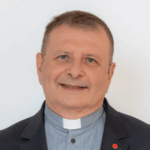
Another large and united family can be found in the residence hall for young men, directly across from the parish office, separated only by the “House of Joy”, as the centre is called that is run by the Missionaries of Charity to care for older and sick people who have been abandoned. “At the moment, we are living with 30 university students, Christians of different religious denominations who have been assigned to the residence hall,” Father David Fernández, a priest from Argentina, says in greeting. He, together with a priest with whom he is friends, belong to the brotherhood of the Institute of the Incarnate Word of Aleppo. “We take care of the residence halls, carry out pastoral duties at the Catholic Cathedral of the Child Jesus as well as a further parish in the city district of Al Midan and coordinate aid for more than 600 families.” Father Fernández climbs the steps leading up the second storey of the building. “A number of people fell victim to a bomb attack on the roofs right over there,” he says. “I had to recover the bodies.”
Forced to go to the front
Albert (name changed), who comes from Qamishli and is currently finishing up his industrial engineering degree, is in his room. “We experienced severe fighting here. A number of my friends had to quit their studies because of it. I decided to risk my life and finish my degree.” Albert is going through a difficult time because all young men are directly drafted for military service to go fight in the war. Anyone studying at a university has a sort of “period of immunity”, but this will end one day and the government does not grant any extensions. He scarcely dares leave the building at the moment for fear of being arrested and sent off to war. “We are trying to find a solution for this,” Father Fernández says.
A further resident, Antranik Kaspar, an economics student, affirms: “Father David is just like a father to us. We greatly appreciate the people who have left their families and their homelands in order to live here with us and help us.” The priest explains, “We look for help wherever we can. We are receiving support from our congregation, but also from other organisations such as the international Catholic pastoral charity Aid to the Church in Need, which has made funding available to us so that we can buy computers and pay tuition fees.” The students are also required to pay a small monthly fee of 3,000 Syrian pounds, about four euros. “This is more symbolic,” he explains. “The economic situation is very difficult and we would not have a chance of surviving without help from abroad.”
Weaam Panous, a robot technology student, is very grateful for the support provided by Aid to the Church in Need. “We thank Father David Fernández and everyone who is helping us from outside of Syria, because it is thanks to their support that we can continue with our studies and work for peace.” [/vc_column_text][/vc_column][/vc_row]

Recommended