Fellow missionary recalls Pope Leo’s dedication to the poor and suffering in Peru
Pope Leo XIV served in Peru during a difficult period, when the Augustinians were under threat from terrorists and the population was struggling. “He made sure the poor were treated with dignity,” says Fr Lydon.
Pope Leo XIV is “going to hear the cry of the suffering Church,” predicts a fellow Augustinian missionary who lived and worked with the future pontiff in Peru for 10 years.
As a missionary in Peru, facing threats in a difficult time in the country, Robert Francis Prevost stood by and spoke up for Christians whose freedom and basic rights were violated, said Father John J. Lydon.

The priest has known the current Pope since their student days at Villanova University. But he really got to know the Holy Father in Trujillo, Peru, where both men worked in a parish on the outskirts of town. “The Augustinians from Chicago, Pope Leo’s hometown, have been doing missions in the north of Peru since 1963. Father Prevost began working in the diocese of Chulucanas in 1985, three years after his ordination to the priesthood. From 1988 to 1999, he was sent to the city of Trujillo, where he served in a variety of functions.”
He was also entrusted with the pastoral care of Our Lady Mother of the Church, later established as the parish of Saint Rita, in a poor suburb of Trujillo. Father Lydon, a native of Toronto, served with Father Prevost in those parishes. He said that when the Augustinians opened a seminary for Peruvian vocations in 1990, Father Prevost was the first one to run it. Father Prevost was “very organised,” he said, “which reflects, I presume, his mathematics studies. He was a good administrator.” More importantly, though, from the standpoint of a missionary, Father Prevost was “very focused on serving”.
“Our parish in southern Trujillo was on the outskirts of Trujillo in those days,” he told Aid to the Church in Need (ACN). “About half of it was a very poor area, so he was very attentive to making sure the poor were treated with dignity, which in those days wasn’t the norm. The poor were always mistreated by the authorities. He gave a different experience to them, one of human dignity.”
“I would say that he took the name Leo because Leo XIII was the pope who gave the first document of Catholic social teaching on workers’ rights and human dignity.”
Accompanying the people despite dangers
The two men were in Peru during the 1990s, a decade of much turmoil in the South American country. “We had The Shining Path, which was a terrorist organisation,” Lydon said. “We tried to accompany and support the people. There were lots of violations of human rights.”
Shining Path (Sendero Luminoso), a communist movement, wanted foreigners out of the country who were helping Peruvians, Father Lydon explained. “There were threats made to us and our parish, and the bishop’s residence up north, there were bombs put there. Their idea was to try to bring down the country and then, from the ashes, build a new society.”
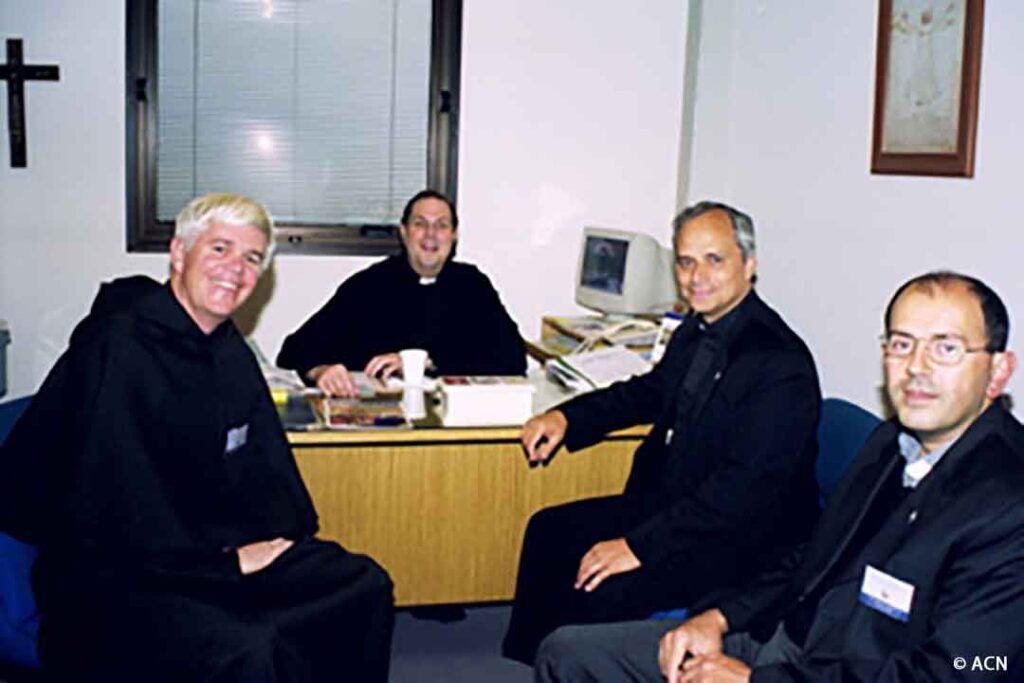
The Midwest Province in Chicago wanted the missionaries to have an evacuation plan, but Fathers Prevost and Lydon, and the dozen other foreign-born Augustinians, felt that a more appropriate response was to “make a plan about how to accompany the people in this time of the Cross, not to leave and look like we’re abandoning them”.
Shining Path was active in the mountains, and this led to an exodus of people to the cities. Many settled in the area of the Augustinians’ parish at the city limits of Trujillo. Since the internally displaced people had left everything behind, they were thrown into poverty. The Augustinians opened soup kitchens in the area, which are still serving the poor there.
Years later, after serving two terms as prior general for the worldwide order, Father Prevost returned to Peru, this time to serve as bishop of the Diocese of Chiclayo. He often wrote to ACN, thanking the pontifical foundation for supporting projects in the diocese, which include the formation of seminarians, missionaries, and catechists – issues that are close to the heart of the new Pope Leo XIV.