Cameroon: It’s not weapons which will defeat Boko Haram, but education and hope
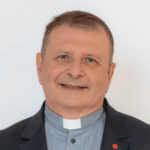
The Diocese of Maroua-Mokolo in the extreme North of Cameroon has suffered sporadic attacks from Boko Haram. Mgr Bruno Ateba shares with Aid to the Church in Need (ACN) his hope for the future through spiritual and educational formation programmes, especially for young people and families. He also explains the importance of translating the Bible into Mafa, a powerful tool to strengthen the faith of a majority Christian tribe.

Since 2013, your Diocese of Maroua-Mokolo, situated on the border with Nigeria, has suffered attacks from the Islamist group Boko Haram. What is the current situation in the diocese?
The situation has been calmer for a while, but there are always sporadic attacks. In military terms, Boko Haram has shrunk. Before they all had heavy weapons. Today that is no longer the case, but they are still bandits who come to steal food, livestock, money and even clothes. The two parishes which lie directly on the border – Mutskar and Nguetchewe –are especially suffering. There are two attacks per month, because the terrorists are hungry. At night, most of the population along the border doesn’t sleep at home; some people even sleep under trees. Most of the time, the army is there to protect the population, but the partisans of Boko Haram in Cameroon tell Boko Haram in Nigeria when the soldiers are not there. The people are afraid. When I go and visit the parishes I am accompanied by soldiers. I call them my ‘guardian angels’.
What do you think are the next steps in fighting Boko Haram and assuring a better future for the country?
It’s not weapons which will solve the problem of Boko Haram. The first thing is formation and work. If young people have prospects, it will be difficult for Boko Haram to recruit new members and brainwash them.
The big project which is close to my heart, and which I hope to be able to carry out in the future with the help of ACN, is the construction of a pastoral centre for human and spiritual formation in Mokolo. Among other things, I want couples to be able to receive a formation in St John Paul II’s Theology of the Body. It will also be a place for them to learn about the education of young women. In our culture, it’s common for a girl to have to marry around the age of 13. From then on, she generally stops going to school. In this centre, therefore, we will start by educating the parents. When you have formed a mother, you have formed a nation. We are also planning to have health sessions on how to feed children. In the rainy season there is cholera here because people drink water without precautions. The centre will also be a place of sharing together the Word of God…
ACN has supported you in translating the Bible into Mafa. Can you explain the importance of this project?
Mafa is the most common language in our diocese and the Mafa here are predominantly Christians. The first French, Italian and Belgian missionaries laid the foundations in translating the liturgical texts into Mafa. But up until now, the Mafa did not have a complete Bible. It’s important to be able to read the Good News in your own language because you’re much more touched by it. That’s what inculturation is. Thanks to this Bible, people will discover much more who God is and who Jesus Christ is. We are proud of this translation work which has taken four years.

In any case, we haven’t got many books in Mafa. The Bible is therefore one of the only books in this language, and even if 50% of the Mafa are illiterate, the new generation knows how to read. Therefore, young people can now learn to read in Mafa with this Bible. It’s marvellous! I thank ACN from the bottom of my heart for this precious support.
In northern Cameroon generally, Christians are nonetheless a small minority. How do you live Christian faith in a Muslim environment?
In the city of Maroua, where I live, there are two million inhabitants, of whom 95% are Muslim and 5% are Christian. The Muslims control everything: trade, transport, politics. We try to provide a witness. The Muslims respect us because of our works. When you take care of the poor and children on the street, you don’t ask whether the person is Muslim or Christian. We are all children of the same Father.
Also, the Muslims send their children to our schools because they appreciate the discipline and the good education. The Muslim children are often the best in the catechetics course! At home they recite the Our Father and the Hail Mary, and the parents don’t have a problem with that. It’s the same thing for our big health centre managed by the Missionary Sisters of Jesus Christ in Bogo: many Muslim women go there, because in the state hospitals they would also be examined by men, which is inconceivable to them. They also appreciate the welcome and the quality of treatment with us. When there were threats of abduction by Boko Haram, I went to see the head of the Muslims to tell him that we were going to close our sisters’ big health centre for security reasons. He didn’t want us to close it and promised to protect us.
Thanks to the benefactors, ACN has been able to accompany and support the Church in Cameroon for more than 30 years. Is there a special message which you would like to address to those who make this support possible?
Most cultures teach their children to say thank you. Once again, I would like to take the opportunity to express my deep gratitude to ACN and to the benefactors who support us in our pastoral work. It’s not easy here, especially because of climatic conditions, poverty and terrorism, but ACN helps us enormously: whether that is in the formation priests and seminarians or with various projects.

A project which was particularly close to my heart when I arrived as a young bishop in 2014 was the construction of the Cathedral of Our Lady of the Assumption in Maroua-Founangue, because until then, the bishop didn’t have his own place to celebrate Mass with all the faithful. The diocese was founded in 1973, but couldn’t build a cathedral, because there were previously lots of needs and priorities in the areas of health and education. My episcopal ordination took place in the city stadium! ACN supported us with the funds, and I thank the foundation from the bottom of my heart. On the day the cathedral was consecrated, in July 2023, we prayed for all the benefactors. In the cathedral, there is a thanksgiving plaque to ACN. Without ACN, we wouldn’t have been able to hold up our heads.
So, I simply say “Vergelt’s Gott!” (may God reward you) because I can’t give anything in return, but God will know how to reward you. I pray for you, dear benefactors, who have a special place in my heart and in our diocese.

Recommended